
Choose the right solution
The Reporting Requirement Work-related Mobility of Persons is mandatory from July 1, 2024, for companies in the Netherlands with more than 100 employees. This reporting obligation is part of the Dutch Climate Agreement and aims to reduce 1.5 megatons of CO2 emissions. Initially, it involves reporting on all commuting and business travel movements. In the future, the government may also set a standard to reduce emissions. Fynch helps organizations comply with this reporting requirement and also reduce emissions in the future. The reporting requirement applies until at least 2030. In other words, choose the right solution!
- User-friendly intuitive survey tool
- Register your commutes with the click of a button
- Entire data collection, monitoring and reporting outsourced
- Guaranteed data privacy and security (ISO 27001)
- High quality data
- Reporting in RVO format
- Implemented within 1 day
Happy customers






Comply to the Reporting Requirement in 3 steps

Employees are invited to login to the Fynch WPM Survey tool. They create their own profile and add their vehicles / modalities. We support SSO via Google and Microsoft.

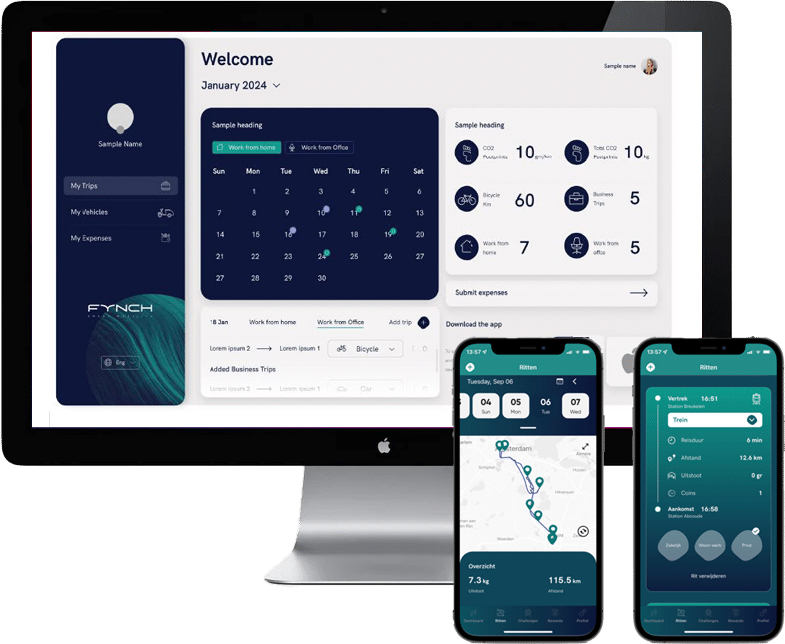
The intuitive calendar function makes submitting daily commutes a breeze. Within minutes employees have registered what is needed to comply with the CO2 reporting requirement.

The employer receives insight into CO2 emissions and other mobility KPIs on an aggregated and anonymized level. The reporting meets the requirements of the Reporting Requirement Work-related Mobility of Persons.

How does the Fynch survey tool work?
Step 1. We set up the Fynch WPM Survey tool for you. We draft the texts for the invitation and reminder emails. These are automatically sent to your employees.
Step 2. Employees login (optional via SSO) and create a one-time profile. Here they indicate their home address and preferred mode of transportation for commuting trips. In addition, they have the option to add multiple commonly used modes of transportation for easy trip administration. Finally, they select the office address that applies to them as their place of work.
Step 3. Employees select the month available to them. They click on the days they traveled to the office and mark it as “office day” Fynch automatically creates two commute trips based on the preferred mode of transportation. Once the employee has used a different mode of transportation, the employee can easily and quickly adjust it.
Step 4. The employee clicks the “submit” button. The data is stored securely. Through Fynch Analytics, various insights about carbon emissions and commuting behavior can be viewed. These insights are only available at the group level and fully anonymized. The necessary data for reporting requirement work-related mobility of persons and submission in the RVO portal will also become available.
To comply with this Dutch reporting requirement, you may also need data from your lease fleet, own fleet, mobility supplier and/or business travel expenses. We are happy to support you with both the collection and processing of this data.
- Intuitive survey web tool
- Reporting in RVO format
- Save time
- Guaranteed data privacy and security (ISO27001)
- Entire data collection, monitoring and reporting outsourced
CO2 reporting. Fynch makes it easy.
- Standard survey tool
- Various data sources
- Time consuming
- Error prone
- No insight into CO2
- Privacy risk
- User-friendly tool
- One central data source
- Completely outsources
- High data quality
- Insight into travel behavior and CO2 footprint
- Guaranteed privacy and security

What is the Reporting Requirement Work-related Mobility of Persons?
The Reporting Requirement Work-related Mobility of Persons obligates employers in the Netherlands with more than 100 employees to report annually on all business and commuting kilometers, divided by mode of transportation and fuel type, including when private cars or bicycles are used. WPM aims to reduce CO2 emissions from business transportation by 1.5 megatons by 2030 compared to 1990.
Initially, no cap on CO2 emissions will be imposed. However, there will be an interim measurement: if the Netherlands is not on schedule in 2026, a cap can be imposed.
The reporting requirement, previously known as the Normative Regulation of Work-related Mobility of Persons, is part of the new Environment Act. The Environment Act is part of the Dutch Climate Agreement.
Here are the key points again:
- Effective date: mandatory as of July 1, 2024
- For whom: all employers in the Netherlands with more than 100 employees
- What: mandatory annual reporting of all business and commuting kilometers, broken down by transportation and fuel type, including when a private car or bicycle is used
- The goal: CO2 emissions from business transportation to be 1.5 megatons below 1990 levels by 2030
- Initially, no emissions cap is imposed
- There will be an interim ceiling: are we not on track in 2026? Then mandatory standards can still be imposed

Legislative history
On March 14, the First Chamber approved the Environment Act, which includes the Reporting Requirement Work-related Mobility of Persons. Reporting for this requirement is allowed as of Jan. 1, but enforcement will start July 1. The Environment Act is part of the climate agreement.
The reporting requirement requires employers to collect and process information from various sources. With Fynch you outsource this completely: your very own reporting assistant! Wondering how we do it? Continue reading!
Sign up for our free online webinar on mandatory CO2 reporting on June 6 at 10:00 am (in Dutch).
Can’t wait? Request the video recording of one of our previous CO2 reporting webinars.
See how others use our software

...ultimately felt that Fynch offered the most options to meet the needs of our diverse staff, from mechanics to managers.
View this case
...ultimately found that Fynch offered the most options to meet the needs of our diverse workforce, from mechanics to managers.
View this case
...is supported by Fynch through its innovative mobility platform in achieving the objectives of the new mobility scheme.
View this caseWe are here to answer all your questions about the Reporting Requirement WPM
No, the RVO does not facilitate a link (yet), but we provide the reports in such a way that you only have to log in and upload the data.
Your personal data is only visible to you, unless an employee of Fynch needs to view the data to help you with something. The data is stored anonymously in the database and can only be processed at an aggregated level (big data). In this case, the individual data points can never be traced back to your account. All data is stored securely and completely GDPR proof in our database.
You decide how long we store your trip data.
See also our page on privacy and our privacy statement.
The basic version of Fynch (Fynch WPM) is arranged within 1 day.
To fulfill the reporting requirement, you need to send all employees a survey in which they have to fill in their travel kilometers themselves. This means first of all that you have to create and send out a survey. The employees must then calculate and fill in the travel kilometers themselves, which can lead to errors. In addition, the data must be supplemented with other sources such as leasing companies, public transport, and expense declaration systems.
With the Fynch platform, entering travel data only takes a few minutes. In the system, the employee chooses his starting point and the software calculates the number of kilometers. This also eliminates errors in the number of kilometers. Employees who haven’t filled in anything will automatically receive a reminder e-mail. If your employees use the Fynch app, the kilometers are calculated automatically.
Fynch collects and compares the various mandatory data sources and processes these correctly in the annual WPM report.
In short: with Fynch the WPM reporting is error-free and fast.
If you are interested in using the Fynch survey tool request a free online demo here.